Anyone who has followed a sports season knows that match day is only the visible part of the job. The real results are built in training sessions, where drills are tied to the moments that decide a game. Certification study works the same way. If you only memorize terms, the exam feels like a stranger. If you connect each topic to a task you would do on a project, the questions start to look familiar.
That idea is the starting point for this guide to the Appian Associate Developer exam. Instead of listing definitions, we will look at what the main exam areas mean in day-to-day work, and how to turn them into a sensible study routine.

Course cover for the Appian Associate Developer practice tests from Be Ready Education
What the exam asks of you
According to Appian's certification information, the Associate Developer exam runs for 60 minutes, costs $250, and uses a cut score of 73 percent. Several community sources describe it as 60 questions, with a mix of single select, multi select, sequencing and matching formats. Appian also limits the number of attempts a person can make, so it pays to arrive prepared rather than treat the first sitting as a trial run. Because the blueprint is updated from time to time, always confirm the current details on Appian's own certification page before you book.
One more point matters for planning. The 73 percent cut score means roughly 44 correct answers out of 60 if the question count is as described. That is a fairly demanding margin, and it rewards steady understanding more than last minute cramming.
Security and access: more than a checkbox
In training, the security topics can look like a list of settings. On a real project they are a daily concern. Who should see a record? Who may start a process? Which team should be able to edit a design object, and which should only view it?
When you study this area, ask yourself practical questions. If a new group of users joins the application next month, which role map would you change, and what would you leave alone? A good habit is to sketch a small application on paper, name three user types, and decide what each can do. Exam questions in this area often describe a scenario and ask for the most sensible configuration, so rehearsing the reasoning is better than memorizing menu names.
Records and data: thinking in terms of the user
Records are where many developers spend much of their time. In practice, you are deciding how data is shown, searched, filtered and acted on. The exam tends to test whether you understand why one design choice is better than another for a given need, not just where the buttons are.
Try this exercise. Pick a simple business need, such as tracking equipment loans for a sports club. List the fields you would store, the views a coordinator would want, and the actions they would take from a single screen. Then ask what could go wrong if two people edited the same item at once. Questions on this theme often hide the answer inside such a scenario.
Process and logic: following the flow
Process modeling asks you to think in sequences. A request comes in, someone reviews it, a decision is made, and a result is sent back. In day-to-day work, the difficulty is rarely drawing the boxes. It is deciding what happens when something unexpected occurs, such as a missing approval or a late response.
For study purposes, take one workflow you know well and write down each step, who owns it, and what data moves between steps. Then change one assumption and see what breaks. This is exactly the kind of thinking that sequencing and matching questions reward, because they test whether you understand order and dependency, not only vocabulary.
Deployment and environments: the quiet skill
Moving work between environments is not glamorous, yet it separates a tidy project from a messy one. Third party study notes often mention deployment as a recurring topic, and it is worth treating it that way even though the official blueprint is the final authority. In real work, you care about what travels together, what must be checked before release, and how to confirm that the live version behaves like the tested one.
A simple routine helps here. Before every practice session, write a three line release checklist from memory. Compare it with the explanation of any question you miss. Over a few weeks the checklist becomes automatic.
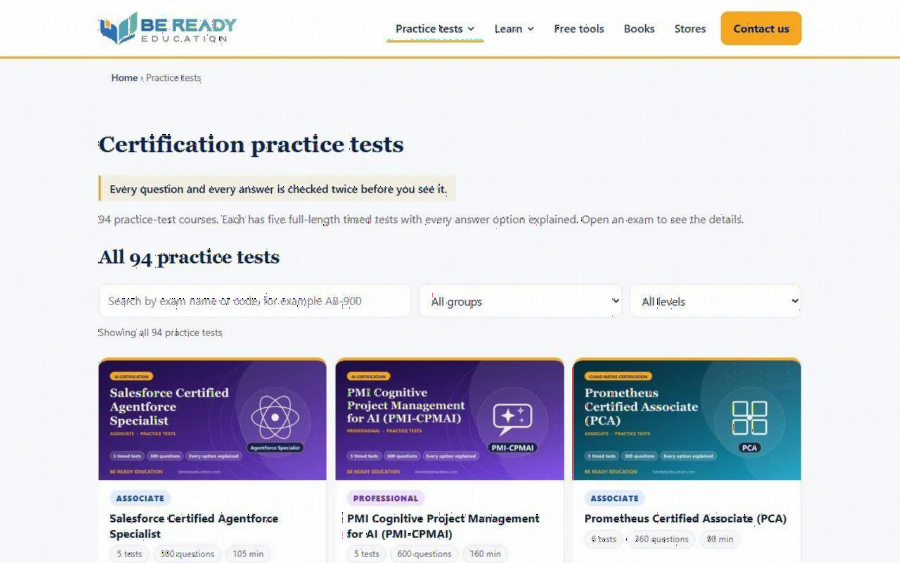
Be Ready Education practice tests page listing certification practice test courses
How a practice test fits into your routine
The Appian Associate Developer course from Be Ready Education is an independent set of practice material. It contains 5 timed practice tests, with 60 questions in each test, so 300 questions in total, and every question comes with an explanation. You can find it here: Appian Associate Developer practice tests.
Here is a way to use it that mirrors good training habits.
1. Take the first test cold, without notes, under the time limit. Treat the score as a baseline, not a verdict.
2. Read every explanation, including those for questions you answered correctly. A right answer reached by luck is a weakness in disguise.
3. Group your misses by theme, such as security, records, process or deployment, and spend your next study block on the weakest theme.
4. Return to the next test only after you have rebuilt something small in the product to fix the gap.
5. Keep the final test for the last week, and time yourself strictly.
Be Ready Education also keeps a wider catalog of certification practice courses at bereadyeducation.com/exams, if you want to compare formats before you start.
An honest note on limits
Practice tests are a rehearsal tool. They do not replace Appian's official learning material, and they cannot give you the judgment that comes from building real applications. This material is independent and is not affiliated with Appian. No course can promise a pass, because results depend on your preparation, your experience and the exam on the day.
What a good set of practice questions can do is show you where your understanding is thin, in a setting where mistakes cost nothing. Combine them with hands-on time in the platform, the official documentation and a steady schedule, and you give yourself a fair chance.
A simple four week plan
If you want a structure to follow, here is one that balances reading, building and testing.
In week one, read the official exam information and take the first practice test cold. Note which themes feel unfamiliar. In week two, spend most of your time building a small application that touches security, records and one process. Rebuilding something forces you to meet the details that questions depend on. In week three, take the second and third tests, review every explanation, and keep a short list of the concepts you keep missing. In week four, take the remaining tests under strict timing, then spend the final days on that list rather than on new material.
Athletes taper before a big event, and you should too. Avoid long late night sessions the day before. A rested mind reads scenario questions more carefully, and careful reading is often the difference between a near miss and a pass.
Final thought
The exam domains are not abstract. Each one maps to a decision you will make on an actual project. Study them as habits, practice under the clock, and use the explanations to correct your thinking. Do that consistently, and match day, in this case exam day, becomes just another session you have already rehearsed.